Your cart is currently empty!
Tag: the gilly diaries
-
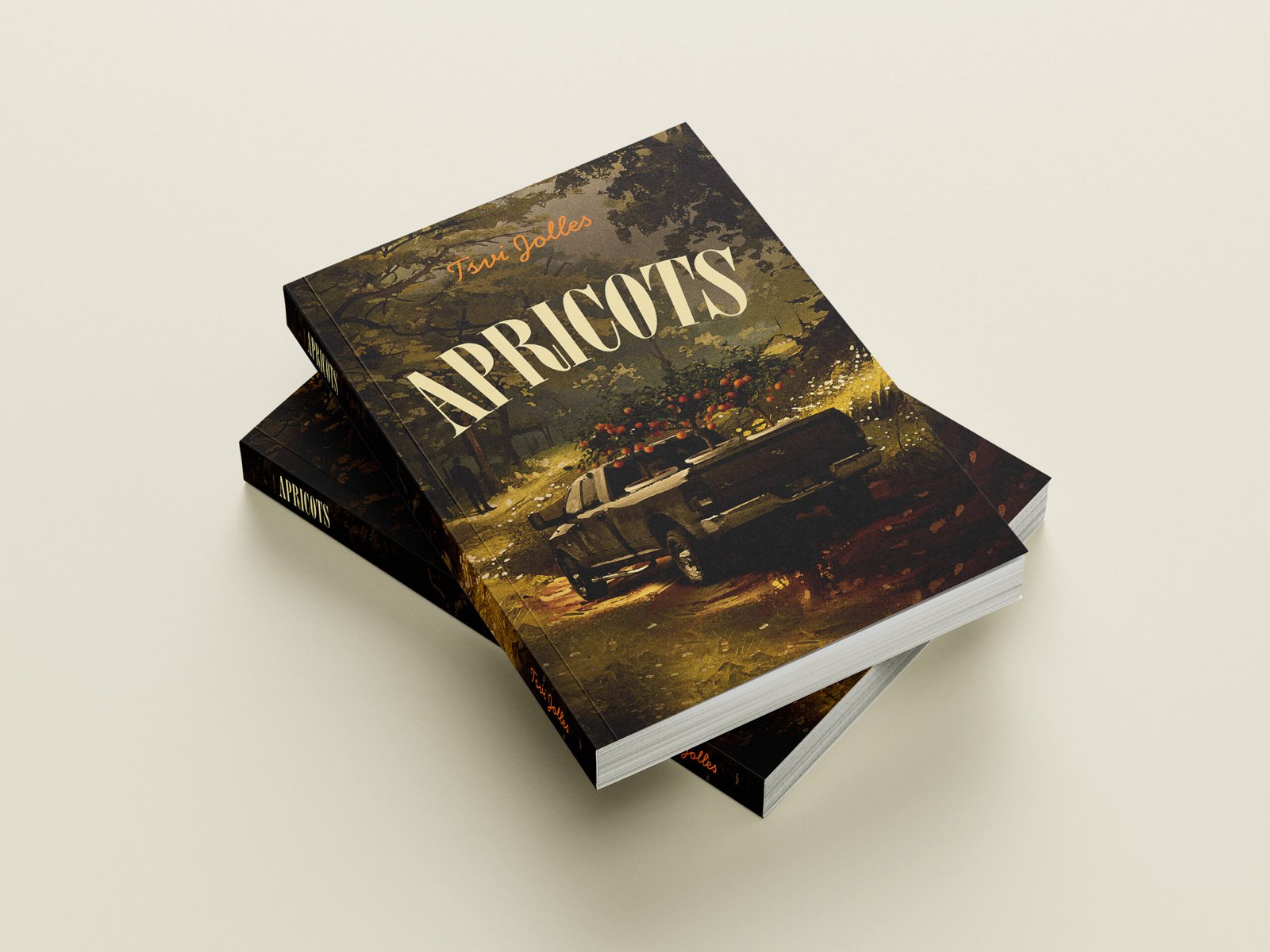
Start Reading Apricots – First Five Chapters Free
The Quiet Things That Stay
It’s been three months since I opened this kind of notebook. Three months since I held the old green pencil—the one that remembers best the things that change and which now has lived half its life already.
In that time, the world has turned. The leaves have let go. The light has slipped away a little sooner each day. The trees look thinner now. The forest feels quieter—so much quieter that sometimes I get the feeling everyone has left, even the birds and the chipmunks, and left me here alone.
But then I hear the blue jay—the one who gossips the most—start a new song that wakes the whole woods up, and I know it was just a mood. One of those moods Orti—my tangerine tree—seems to have more and more lately.
So I thought maybe I’d start this first page—in a very humble way, which is always the best way to walk around here—by listing the things that haven’t changed.
I’ll do that now.
THINGS THAT ARE STILL THE SAME
My mom (even though she used to be a circle and now she’s a line—I’ll explain later),
Dad,
Oggy,
Mississippi,
Odelia, and Eternity.
The gardener,
The man with the white beard,
My home,
Oggy’s home,
Orti—my tangerine tree.
The open fields,
The Green River near our house,
Sabigail the yanaka,
Queen Lulula the dancing monkey,
Neretz the cherry tree.
The witch house,
The ship house,
The mountains—all ten of them.
The Four Seasons train.
And the sunset. That hasn’t changed either. Even though, as I just mentioned, it shows up earlier now. Still, it feels like the same one I’ve always known.
Obviously, if much of that list doesn’t make sense to you, it’s probably because my first diary didn’t become a famous book—and neither did I—so you never got the chance to read about them. But believe me, they were part of my life. They still are. And they always will be.
What’s funny about the things that stay the same is that if you look close—really close—you start to see how they’ve changed, too.
Or maybe you changed right along with them.
Like you and everything else moved a little each day—but nobody said a word about it, so it feels like nobody moved at all.
Isn’t that a kind of magic? I could call it The Everyone’s-Drifting-So-No-One-Notices Effect.
Or maybe just The Staygo.
I guess the one thing that really does feel like a change is that my mom gave birth to my new sister, Gilma—a name Oggy made up and Mom just happened to love. The other big thing: Dad can now see me every wonderful Tuesday for twenty-five minutes—not one minute more—which is also a pretty big change.
What else? Mississippi and I talk more now. Sometimes we even go places together, just the two of us.
So while nothing is exactly like it used to be, I’m glad most things are more or less as they were—in the same place, or at least very close by. Because even when things shift and drift, the important things—they really want to stay put.
And you just have to let them.
Closer
Today I climbed Orti to say a new prayer I wrote just for Mississippi. I whispered:
Dear forest,
send Mississippi someone
who’ll make her laugh—
louder than winning at cards,
sweeter than apricot jam,
and warmer than sunlight
on a cold November morning
(like this one).
Amen.Prayers feel like they reach higher when you’re sitting in a tree. I never thought about it before, but then Oggy told me about a half-girl, half-wolf who climbed high into the snowy mountains because she believed it brought her words closer to the gods’ ears.
At first, I wasn’t sure—mainly because Oggy said it was from Greek my-tho-lo-gy, which sounds impressive but also kind of suspicious when he waggles his eyebrows and says it in that very-sure-but-also-very-made-up voice.
But once Oggy said it, the usual thing happened. I started to wonder.
What if there really was such a girl-wolf? And what if she had glowing amber eyes and pointed, silver-tipped ears, and sounded so wild and lonely at night when she howled at the moon? And what if she looked a little like me (wearing sandals with funny toes)? Or woke up at night sometimes, like I do, and thought about all kinds of things?
So I kept thinking about her—until she felt more and more like someone I actually knew. Not just a story. And that’s when I started climbing Orti whenever I had something important to say to the sky.
But I should also explain why I prayed for Mississippi in the first place, shouldn’t I? It’s a good story.
We spend more time together now—not just when she visits to play cards with Mom and Odelia and Eternity, but also when she drives me to Odelia’s house every Tuesday to see Dad, or when we wander along the path that leads to the Green River, or when we take her car (the only one around here) out for a drive and go to see the turtles in the salty lake.
(Which isn’t really a salty lake—only called that around here, and nobody’s sure why. Maybe it used to be salty a long time ago, and the very old generations called it that until the name stuck, even though there are fish and frogs and floating leaves in it—and you can even swim.
Or maybe it’s because couples sometimes go there and walk along the edge, and some kinds of love—especially the heartbreak kind—can end up pretty salty.)
I’ve been there three times with Mississippi, and they were all super sweet.
Like Mississippi herself.
She feels more like a big sister now than just Mom’s friend or an aunt.
The other day, right after we saw a feather caught on a branch and gave it a wish, she told me she felt it was finally her time to find her own jam. When she said that, I was so happy I wasn’t watching where I stepped—and my foot sank right into a dip in the path, hidden under leaves. My ankle twisted, and I tumbled forward, scraping my knees and getting dirt and bits of moss all over my clothes. But even as I sat there on the forest floor, I was still smiling—just as happy as I was before I fell.
Falling into a leafy hole doesn’t change your mood. As long as it’s not into muddy water.
Or brambles.
Or nettles.
Or thorn bushes. Because those can swap your mood completely—from sunshine to storm clouds—faster than you can say “snukka snukka.”
I have to explain two things quickly (or maybe it’s three?) because too much explaining—or too much talking in general—is not a good idea right after you’ve said a prayer.
First—“snukka snukka” is a real sound you can hear by gently touching the nose of a yanaka. Yanakas live only in our forest, and Oggy says that without me seeing them, they wouldn’t even exist. They’re as tall as llamas, as hairy as llamas, and can spit like llamas—but they aren’t llamas at all. They’re just … yanakas.
And the other thing—“finding your own kind of jam” in our forest means finding someone who’ll love you. Romantic-kind-of-love you. Here, everyone makes, sells, or buys jam. So nothing is more common than jam—just like nothing is more common, or more special, than wanting to find the person who’s meant to love you.
Now that I’ve explained it all, I can rest and wait for the prayer to drift up into the sky. But the moment I see Oggy stepping out of his house and looking this way, I know this peaceful waiting isn’t going to last long.
I Can Count Just Fine
We don’t get many trucks on our road. But today, one stopped at Oggy’s place. In the back were six trees, all thin and shy, like they didn’t know where they were going yet.
Mr. and Mrs. Bloom looked out from their blue-trimmed windows, then rushed out their blue door, chatting away with the driver, who scratched at his blue cap. Mr. Bloom kept waving toward the corner of their big round yard—where the blue flag was flapping.
Around here, if you’re getting a delivery—like gravel or garden tools—you put up a flag in the yard, because we don’t really have street names or house numbers, and delivery trucks get it wrong a lot.
We’re the ones who live where the road ends and the forest begins.
Since the Blooms like blue best, I guess that’s why they put up a blue one.
From where I’m sitting, it looks like Mr. Bloom has a lot to say to that truck driver.
Maybe he’s just telling him where he wants the trees to go.
Or maybe he’s telling the driver: “Look at this—so much blue. My wife adores blue, so there you have it. A clear explanation. And you didn’t even ask a thing. Of course, there are other colors she loves too—like wet moss green or sweet tangerine orange—but if I have to guess what kind of new vase or tablecloth or socks to buy for her, I’ll probably stick with the blue.”
But since I’m about a hundred steps—measured by me—I can’t hear what they’re actually saying, which somehow makes it even more fun, watching from between Orti’s branches.
What if the driver says he found them growing in the wrong place, like a parking lot or behind a gas station, and decided they deserved better. In that case, the driver could really be someone trees pray for when they need help—and he’s the one who hears them.
Or maybe he’s a tree matchmaker, and he thinks these six will fall in love with the soil in Mr. Bloom’s yard.
Or maybe he’s just tired and needed a reason to stop and rest—and now he asks if they have cookies. And if they do—warm, chocolate-chip ones—he’ll trade six trees for just one.
With a glass of cold milk, of course.
Just like I guessed, Oggy didn’t stick around with his folks. He came straight to me, sneakers kicking up little dust storms.
Oggy loves doing that, of course—stomping pebbles, cracking twigs, stirring up dirt. He likes being seen from far away—heard, too—which might be the best way to explain who Oggy is.
I don’t mind. Oggy’s just Oggy.
I’d still like him even if he slid through a mud puddle and ended up with twigs in his hair. (Actually, if that really happened, I might like him even more.)
Anyway, I hopped down from Orti, my sandals hitting the ground with a good, solid thwack—raising just enough dust to remind him that fancy sneakers aren’t the only way to kick up a bit of drama. Plain sandals do the job just fine.
Then I looked at him, pointed back at the driver with the blue cap—who was now standing near the flapping blue flag—and said, “Maybe he told Mr. Bloom he woke up with them in his truck and nobody knows how they got there—not even him.”
So Oggy said, “What the pinecones are you talking about, Gilly?”
But I knew the look on his face—it was the pretending-not-to-know face. So I just pointed harder and said, “What’s with the big pickup truck? Why’s it even at your house?”
Oggy stuffed his hands in his pockets and mumbled that there are six of them.
So I said I can see there are six. I can count pretty well.
Then he said he knows that because everybody in the forest—and beyond—knows I’m ob-sessed with counting things.
And I said, “Oh yeah, like what?”—but I really didn’t want him to start listing all the things I count or used to count, especially not the etched hearts on Orti, because those are the most private.
So I just pointed at the sky and said, “Look how blue the sky is today. So blue. As blue as your front door, as blue as the cup on that driver’s balding head, as blue as the flapping flag at the edge of your gravel.”
He looked at me like he was counting all the times I’ve done just that—changed the subject on him just because I didn’t feel comfortable talking about something.
Still, I was the one who started the whole thing by talking about the trees. So I gave in and asked, “Why apricots?”
And he said that there are two reasons, not one, but he’s not sure it’s time to tell me the second one.
“What’s the first?” I asked.
“It’s just my mom … Mrs. Bloom,” he said. “She loves apricot jam best of all jams. So now she’ll have more to pile on her toast.”
Oggy almost always remembers to call her Mrs. Bloom, not just Mom, because she’s not the one who gave birth to him—but I’ve counted more than a few times he didn’t.
His real parents were Ace and Azure. And every time he says it like that—calls Mrs. Bloom Mom too—I feel like hugging him or saying something kind. Like maybe his real mom sent me to do it.
Instead of giving him a hug, I gave him half a tangerine I’d just picked from Orti—which is pretty much the same thing as giving a hug. I peeled it for him (like his first mom might have done) and handed it over, and he stuffed it right into his mouth. Then I peeled one for myself—because I need my own hugs, too, like everyone—and when our eyes met, I could almost see his thoughts. He was super proud of knowing something I didn’t.
I finished the tangerine, kicked some dust with my sandals, and said, “Okay, come on. Give me a hint. What’s this other secret about?”
He just said that things are changing fast, and not everyone can handle that—especially not the extra sensitive. Like me.
I told him I’m not extra anything and that he should stop being so grown-up about everything. (Which was kind of rude—and kind of a lie—but for some reason I just couldn’t help it, standing there under my tangerine tree.)
So he went quiet—extra quiet—as if to prove something. And he probably did, because I went right on, asking again, “Come on—what’s going to change?”
He said all he could say was that it’s something that’s going to affect everyone’s feelings—his, his parents’, and probably mine too.
I tried so hard to figure out how six apricot trees could mess with everyone’s feelings, but my brain was as empty and hollow as a joompa—a hole in a trunk. Which is weird, because that just doesn’t happen. I’m almost never out of ideas.
Maybe the tangerine’s sweetness made my thoughts a little sticky for a while.
So I acted like I didn’t care and asked Oggy if he wanted to play Queen of Feathers—the game we made up where you toss pinecones into the river, each with a tiny feather tucked between the scales, and see which one floats away faster. The first to disappear around the bend wins—unless your feather falls out or sinks. Then your pinecone queen loses the round. No excuses.
We played for a whole hour, until the big pickup truck finally rumbled away. Then Oggy said he had to go home because of this new secret, and that he was sorry for leaving right when he was still ahead—nine to eight.
He’d been leading nine to one, but then I found the right pinecones and the right feathers and almost turned the whole thing around. But this is Oggy. He can’t lose.
As he ran down the hill, the six young trees stood tall in the dirt—like they were all looking straight at me. It felt like Mr. and Mrs. Bloom, and Oggy, and even the trees were in on something—and I was the only one not invited. Just standing there, with dust on my sandals and nothing to do but wait.
What a classic Monday.
Never mind. Tomorrow is Special Tuesday.
Paper Boats in the Soft Light
Tuesdays are when I see Dad.
We meet at Odelia’s house, because Mississippi says it’s better to pick somewhere that’s not his or mine.
Odelia’s place is quiet. There’s not much in it—just a couple of chairs, a small rug she once called a Persian rug (so maybe it is), a nice kitchen table with only salt and pepper on it, and a single shelf of books—mostly cookbooks, but also a few poetry ones I plan to read all the way through.
The lights in both rooms (there are just two) are kind of yellowish—not bright, just soft and warm, like the sun feels at the end of the day when you’re sitting on a branch of Orti.
There’s no TV. No computers open on the counter. Not even colorful orangey cushions on the sofa, like we have at home. Nothing that tries to grab your eyes or ears (or even your nose) too much.
Well, except for the glass parrot on the side table. That one definitely wants attention.
Mississippi says Odelia got it from a friend who lives all the way on the other side of the world.
Sometimes, when the parrot wants me to look at it for a whole long minute, I picture that friend sitting by his windowsill near the ocean—or maybe on a porch—with a bright shirt that’s not all the way buttoned, shiny rings on every finger, and a feather tucked behind his ear.
He’s sipping coffee and carrying one of his glass parrots on his shoulder.
Mostly he’s writing letters and postcards with a blue ink pen, and there’s a lot of coffee smell in the room (but also the smell of salty air), and mostly candlelight when it gets dark.I don’t mind places with those soft, yellowish lights—I actually kind of love them.
They’re nothing like the man with the white beard’s guest house, where the lights are so bright they flood everything, and you have to put your hand above your eyes just to see.
At our house, I think it’s kind of in the middle.
But I don’t really remember what the lights felt like back when my dad still lived with us. Maybe they were more mellow-yellow.
Or maybe not.
The photos I have from back then—mostly in the green album, and a few in the red one—don’t really show it. Light in pictures always looks different anyway.
Even the one photo from the guest house, with Mom and me and the man with the white beard, looks all soft and dim, like the lights forgot how blinding they really were.
But I remember.
Sometimes I sit in my room, looking out at the fields and the sunset (they’re in the same direction), just letting the light fade until everything’s almost chocolate-dark—the kind with no milk. Then I light my little duck-shaped candle, the one that smells more like lemon than duck, and just stare at it, wishing every hour was like that.
When I’m calm, I know just what to do. But when my head gets rainy, or foggy, or all windy—or when my thoughts turn heavy, like big hailstones—I get mixed up. I still do things, but later I might think … hmm, maybe not my best idea.
Writing in my notebook by duck-candlelight turns my worries into little paper boats. The words dance and wiggle, and sometimes even make tiny quack sounds, like they’re happy to be born on my page.
So maybe I’m more like Dad than I thought. Maybe I need to get away from all the stuff that feels too much, too.
Today, I asked Mom if she could make a gift for my visit to Odelia’s—later this afternoon—to see Dad. She said she’d make special jam—not the usual kind we get from Olaf the Second, that chatty jam vendor.
I got so excited! Mom’s one of the only people around here who doesn’t make or sell jam—she just buys it from Olaf. So her making it herself, just because I asked, means it’ll be super special.
For real.
For me.
And for Dad.
I bet while Mom makes that jam, she’ll think sweet thoughts about Dad—maybe some good memories from before. It’s got to be hard to make jam for someone without at least one tiny, sugary thought about them.
I mean, maybe if she were making plain rice, or eggs, or even potato salad, sure—
but jam is the kind of food that brings all the feelings up, even before you eat it.She also said she’ll make enough for me to take to school, which made me wonder what the other kids will say. Or maybe I’ll just eat it quietly, not telling anyone it’s probably the best jam in the whole forest.
That might make it even more special.
Did I even mention that I started going back to school after being away for months last year?
It all started after I told Mom about my night trip through the forest with Oggy and Sabigail—to see Dad, for the first time in almost a thousand sunsets. Her eyes got big (probably just like mine when I’m scared and happy all at once). Then she asked what other wild adventures I had planned for the rest of the summer.
I thought hard, and the only wild thing I could come up with wasn’t catching snake-like creatures with Oggy and Sabigail, or wrestling monkeys in the trees, or anything like that. It was just … going back to school.
I never used to think of that as wild—and I guess most kids my age wouldn’t either—
but after all that time staying home, etching hearts into Orti and waiting for Oggy to get back from school, the idea felt like the wildest thing I could imagine.Maybe because, suddenly, it looked scary. (Going back to school. Seeing kids my age again.)
Scarier than crossing the forest in the dark.
Last year, I stopped going to school after too many kids laughed at too many of my thoughts—sometimes all of them. So Mom started teaching me at home. It was fun sometimes, but other times it felt a little like living on the moon.
Alone. (Which I did once—but not for long.)
Still, I was too afraid to even think about going back. So I started a whole notebook called:
WHY I’LL NEVER GO BACK TO …
I didn’t even write the name of the place I meant.
Not on the cover.
Not even inside.
The funny thing about fear is that, as time goes by, you keep ending up in that part of the woods where two roads just sit there, waiting. One of them whispers, Come here. The other doesn’t say a word.
The silent road always has more branches on the ground, pits, holes, thorns, nettles, brambles, and tangly vines—plus wasp nests in the trees, under the leaves, or dangling from the darkest corners.
So, yes, it’s tempting to choose the other one—the smooth, easy-looking path that keeps saying, Come here, come here.
But if you pick the thorny road—the one that doesn’t call you in—a strange thing happens. You get scratched, you get bruised, you get muddy … but the deeper you go, the better you feel.
You walk until you reach a clearing (where most of the monkeys live). From the little hill there, you can see all the way to the Salty Lake and the faraway mountains. It’s the best view you could ever get.
I know that thorny road is the better one—because I’ve walked it. I’ve seen that view. And even though I had to turn back after I got there, if I ever face a choice like that again—if fear tries to boss me around—I’ll still go the hard way.
Going back to school was like that. Scratchy. Weird. A little muddy. But I’m glad I did it. Really glad. Because sometimes the bravest thing isn’t wrestling a monkey or sneaking through the forest at night. Sometimes it’s walking through a door you used to be too scared to open. And finding out it still opens just fine.
A Train Full of Thoughts
At school, I learn all kinds of things—some I didn’t even know I needed to learn. Like how certain numbers go on forever without ever repeating (like Pi), or how a graph can tell a whole story without using a single word.
To be honest, I prefer stories that do use words.
And while I believe in infinity—mostly because of Oggy, who swears he once counted all the way there—I’d rather stick to things that are more fun to count. Things that don’t take up half your lifetime.
They also teach us things like this:
Say there’s an old oak tree with a bunch of acorns, and a team of squirrels has to figure out how many to eat now, how many to hide in secret spots for later, and how many to stash in case winter comes early.
You have to calculate it all—depending on how many squirrels there are, how many hiding places they can remember, and how many acorns each squirrel can carry in their tiny paws without dropping any.
I actually like those kinds of problems, because I sort of feel like I am one of the squirrels—leaping through leaves, nose twitching, figuring things out.
Then there are the ones about trains and buses leaving stations at different times and traveling at different speeds—and somehow you’re supposed to figure out when they’ll arrive. I don’t like those. They make me feel lost in a jungle of concrete, and the numbers I come up with are never the right ones.
If only they’d just keep it to squirrels and acorns.
Still, there’s one subject—and one teacher—who makes me smile the second I wake up, just knowing they’ll be part of my day.
Her name is Mrs. Karabach, and she teaches us creative writing or as she calls it: “Imagination gym.”
She’s got these green-green eyes and a smile so bright, she could totally star in a commercial—like one where someone wakes up brushing their teeth in the middle of a jungle, and monkeys, birds, and even a sleepy tiger all crowd outside her cabin window just to see her grin.
But of course, she’s not in any commercials—because Mrs. Karabach doesn’t even own a TV.
She mentioned that once in class, saying she prefers the stories in books and the pictures we make in our heads—and it made me like her even more, since it means she’s like Mom and me.
And Dad.
And Eternity.
And Oggy. And both his parents—though they do like watching movies in their yard sometimes on Wednesdays, with bread and apricot jam.
Mississippi watches romance stuff now and then—I know because she told me, but she said it so quietly (which she never does) that I could tell it was meant to be a secret.
The man with the white beard watches a lot too, in his guest house with the blinding lights—but mostly sports, I think, and only when guests are around.
Odelia watches the news from faraway places, places beyond our forest, so she always knows what’s happening in the world. Then she usually needs extra mint tea and a few almond cookies to calm down from whatever she just heard.
I don’t need any mint tea or almond cookies when I’m in Mrs. Karabach’s creative writing class. It’s the only class where I forget I’m even in school—and probably the one thing I’d still do even if no one asked me to. Maybe even if they told me not to.
On my very first day back at school, Mrs. Karabach took me aside and said she already knew all about my story. I still don’t know how she knew, because my notebook journal is a secret—I’ve never shown it to anyone. Not even Oggy.
The only creatures who’ve ever peeked inside are Sabigail and maybe Queen Lulula, my two best friends from the night Oggy and I crossed the forest. But I don’t think they talk to Mrs. Karabach. If they did, she probably would’ve mentioned how funny Sabigail’s teeth are—or asked what kind of monkey Lulula is, exactly.
Still, Mrs. Karabach knew things about me, and she said she wanted to work with me personally on my writing.
Maybe she found something I wrote last year, before I stopped coming to school. Or maybe she talked to the principal, Mrs. Tata, and learned a few things that way—since Mrs. Karabach only started teaching at our school after I left.
Starting on the second day, we sat together during recess—then again on the third day, and the fifth, and almost every day since—and talked about writing.
At first, I didn’t understand why she was doing this. She has lots of other students, not to mention her own recess time—to rest or to meet the other teachers in the oval-shaped teachers’ room, the one with the almost-happy, twisty lemon tree by the window.
But then one day, she leaned in, her green-green-green eyes looking right at me, and said, “Gilly, I think you have a very special talent. One that even you’re not aware of—which isn’t a bad thing, by the way.”
Then she told me she’d had doubts about saying anything at all—because sometimes it’s better not to let people know what they have, so they can just keep being themselves. Still, she said she couldn’t help herself—and just hoped it wasn’t the wrong thing to do.
To be honest, after she told me that, I didn’t feel any different.
Except maybe I scratched my left arm more than usual and rolled my eyes a few extra times that afternoon. But nothing big. Nothing that would make Oggy suspect something had changed in me—or gone wrong, or anything like that.
Then I imagined telling Oggy what Mrs. Karabach said, and how he’d probably roll his eyes and go, “She says that to every new kid. Especially the ones who come back after missing almost a whole year.”
He’d probably add that she told him he was even more talented than me.
That thought probably made me smile—even the next day at recess, when I sat with her again to work on my writing. Toward the end of our little meeting, Mrs. Karabach asked, “Can I give you some friendly advice about your diary writing?”
I said yes right away, even though I wasn’t totally sure I wanted advice. I can sometimes be pretty suspicious about advice from anyone, because I’ve learned that people usually give you the advice they’re afraid to give themselves. Or at least, that’s how it feels sometimes. After (almost) eleven years of living, I think I might be better off without those kinds of advice.
Except the ones I get from Mississippi. Those are a different kind of advice. The kind I actually look forward to. Also because they’re rare—and they have the fragrance of mossy tree bark and the taste of mint leaves.
In that quiet recess, the one that felt really long, after I agreed to get her advice, Mrs. Karabach started asking me all sorts of questions—some easy, some that made me shift in my seat a lot—and had me write sentences and little stories about everything. Then she leaned back and said, “Gilly, maybe try working on your stories so they don’t feel so cut up and jumpy. Try making them flow, like a train on a track with a very clear destination.”
So the one more thing about advice I’ve noticed is that you can get the worst kind from the people you admire most—or the best from the ones you try to dodge in the hallway.
It’s like opening a fancy chocolate in a shiny gold wrapper (like the one Charlie finds in that book about the chocolate factory) and finding it melted into the shape of nothing, stuck to the foil like a sad puddle—then opening a wrinkly lunch bag that smells a little like pickles, and finding the best cookie, perfectly soft, with just the right amount of cinnamon, and a small cup of milk you didn’t even know you needed.
Of course I didn’t tell her anything. I didn’t even mention the Willy Wonka book as a secret hint. I just stayed polite—like we all do in our family (when we’re calm)—and nodded.
I’d never thought my stories were cut up, or jumpy, or wrong—until the exact moment she gave me that advice. A grown-up kind of advice, dressed up as something helpful.
Of course she didn’t say they were wrong—but my brain’s really good at translating words into worse ones. Then she said more stuff—about my talent and how I should use it better. Or even betterer.
And finally, she asked, “You’re okay with that?”
I nodded again even though I was pretty certain that stories, like trains, don’t need a clear destination. Take the Four Seasons Train, for example—it passes pretty close to our place, and no one really knows where it’s headed. All we know is you have to see it when it goes by—four times a year—or else you’ll be stuck in the previous season.
Anyway, because it was Mrs. Karabach saying it, I promised to try.