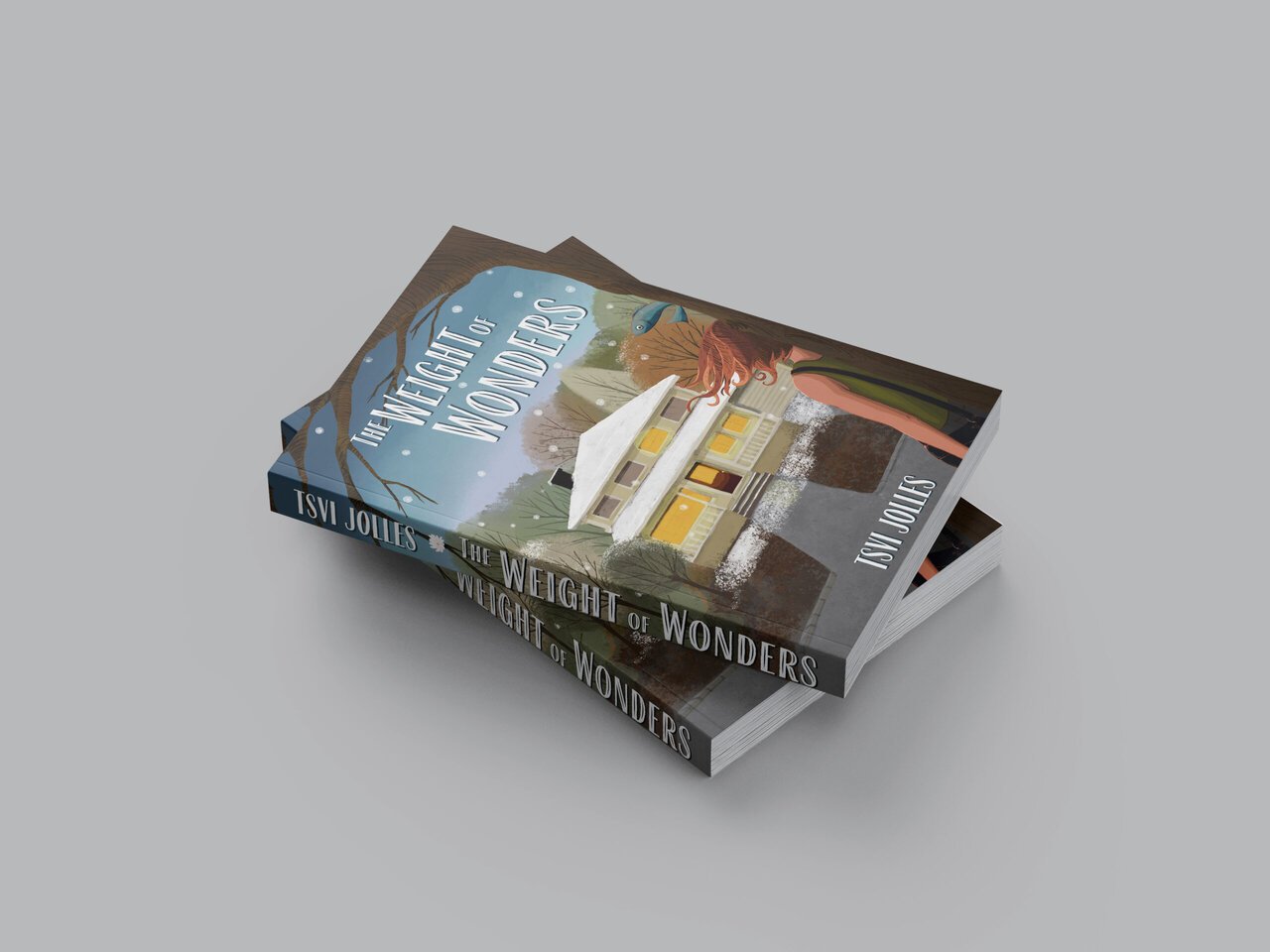
A Note to My Readers
The Weight of Wonders is my first novel for adults. It follows Simon, a writer caught between the life he built and the life that keeps calling him back, as he’s pulled into a chain of extraordinary events.
What follows is the opening chapter of the book. I hope you enjoy stepping into this world for the very first time.
***
That afternoon, as Renée steered us through Leicester, North Carolina, I was half lost in a daydream when she leaned forward over the wheel and pointed ahead.
“Look — a synagogue!” she said.
It wasn’t. Just a weathered barn, a bright blue Star of David strung in bulbs, and beneath it, in big block letters: HAPPY BIRTHDAY, JESUS!
I grinned. “Finally—a Christmas decoration that remembers its own backstory.”
Renée smirked without looking away from the road. “Backstory?”
“Christ was Jewish,” I said.
“So?”
“So the Star of David kind of makes sense for his birthday card, don’t you think? Feels like the first time I’ve seen one of our symbols used right since we left Paris.”
Renée flicked the turn signal as if to underline her point. “No way a barn in Carolina is ever going to remind me of home—even if they strung up the whole Eiffel Tower here.”
“Can you pull over for a minute?” I asked. “I want to look at this little miracle in the middle of nowhere.”
“Seriously, Dad? We’re stopping for a barn?” Augie groaned from the back seat. At thirteen, he was against any form of traveling, and whenever plans took the smallest detour, he was quick to blast his protest.
“Just for sixty seconds, I promise,” I said. “Think of it like a timeout in basketball—here and gone before you notice—then we’re back on the road.”
“Timeout’s actually seventy-five seconds,” he corrected, then added that it used to be a hundred until a few years ago. “In college it can be sixty, or even thirty. Which one are you talking about?”
“Just don’t worry about it,” I said. “We’ll be moving again before you can say Larry Bird.”
“Oh, please,” he muttered, not bothering to hide his tone, “and stop mentioning players from a thousand years ago, as if you actually watched them play.”
Renée pulled the car onto the shoulder, and for a moment we just sat there, the winter sun sliding across the glass and Augie thumping his heels against the back of my seat. The barn loomed ahead—weather-beaten and, unlike Augie, remarkably patient, as if it had been waiting half a century for someone to stop and notice. The string of lights clung to its faded boards, making them look a little less tired. It reminded me of the Roanoke Star we’d seen last Christmas, during our vacation in Virginia—only smaller, humbler, and, in its way, almost kosher.
“So many bulbs,” Renée said. “It’s like the Champs-Élysées at Christmas—only four thousand miles away and a few centuries behind.”
I opened the side window and let the crisp December air bite at my face. “I wonder which farmer in North Carolina strings up a thing like this? Someone went to a lot of trouble for it. Maybe a hundred old style bulbs, maybe more. And this isn’t a road too many people pass. It’s a ghost of a road—maybe fifty cars the whole day, if that.”
Renée and Augie didn’t seem nearly as taken with the sight as I was. Their attention had already drifted to the cattle grazing in a nearby pasture.
“Can we go now? Your minute’s up.”
“Just one more,” I said, still staring at the barn. It felt so abandoned and at the same time strangely cared for.
“Dad!” he groaned, sneakers thumping against the back of my seat. “You said it’d be over before I could say Larry Bird. If you hadn’t said that, fine, but you did. Mom heard. I said Larry Bird, and we’re still here. Actually, I could’ve said Giannis Antetokounmpo ten times by now. Come on …”
“Who’s Giannis … Anta—kokonumpo?”
“Antetokounmpo,” he corrected. “He plays for the Bucks—Milwaukee Bucks—and I really don’t have time for this. Can we please go? And next time don’t say stuff you can’t keep.”
I knew I only had a few seconds before the buzzer would go off—before his muttering turned into outright rebellion. I breathed in the cold air from outside and filled my eyes with one last vision of the barn and its glowing star. I imagined Jesus visiting that very same barn and celebrating a birthday with some of his disciples and a few shepherds who brought a flute and sang him a tune. It probably made me smile to think of it.
Then I flicked the radio on, and the first song that came up was Jesus Was a Lonely Son. It was just before Christmas, so no great surprise there—but still. That song, that moment when we eased back onto the road, pulling away from that barn, somehow sank into me more deeply than I could explain.
“Bruce Springsteen,” I murmured.
From the back seat Augie asked, “Who’s he?”
“He’s like the influencer of my generation,” I said, “but instead of TikToks he gave us four-hour concerts. Think Ed Sheeran, but with gravel in his throat. Or Drake, only with less streaming and a lot more sweat. Or Taylor Swift—but instead of heartbreak, he mostly sang about factories and highways.”
“Okay, you lost me at Taylor Swift,” Augie said, turning to his mom. “Mom, can we please go faster? Or at least let me change the station to something less … ancient?”
By the time we’d crossed into South Carolina, the music was all static, and at some point, when Augie swayed into sleep in the back, I turned it off and let out a sigh of relief. Then we drove on in silence which, after all that noise, felt almost holy.
That’s when Renée leaned over and asked if I was still thinking about that Star of David.
“How do you know?” I said.
“Well … you’ve had the same squinty, far-off look for the last ten miles. Plus, you just tried to drink from the wrong side of your water bottle.”
I admitted I was — that it had been beautiful in a way I couldn’t quite name. Then I added, it felt like Jesus himself might’ve stopped there once, just to rest, and somehow never left.
Then Renée wondered aloud why Jesus would hang a sign wishing himself a happy birthday, if this really was his new home.
I told her it wasn’t about wishing—it was about inviting. Christ, I said, had always known how to draw people in. Maybe not him alone, but his friends, his apostles … they’d been naturals at marketing since the very beginning.
We kept driving—past miles of bare trees, old cotton fields gone stiff and gray for winter, and the occasional gospel billboard, one shouting JESUS SAVES in peeling black paint, another promising HELL IS REAL in letters tall as a barn—when Augie, having finished his share of road napping, let out a loud, theatrical yawn from the back seat. “Dad,” he said, “where are we even going now?”
“Greenville, South Carolina,” I said.
He groaned. “Why can’t we just go home? We’ve already spent two nights in that—what do you even call it? That motel? That cabin? Whatever. I’d really like it if we could skip this whole thing and just go back home already. Actually stretch out in my own bed for once.”
“Well, too late now,” Renée said, her hands steady on the wheel. “Your dad already booked this one for us.”
Augie slumped deeper, his voice dripping with teenage indignation. “Why can’t we just have a two- or three-day vacation like normal families? Or no vacation at all, like even more normal families? Why do we have to be the only ones who drag it out forever and keep moving from one weird place to another?”
“Because your dad is happy when we do it,” Renée said.
And as much as I hated arguments that spun into nowhere, I leaned closer to her and whispered, “My stomach is happy too. Best digestion I’ve got is when we’re on the road. Problems start only when we settle back into the home routine. Go figure.”
“Can’t you just take something for your stomach or whatever,” Augie shot back, “and we can forget about all this wandering circus?”
“If only I knew what to take,” I said. “Seems like the best—if not the only—real medicine for me is exactly what we’re doing right now.”
“You’re so weird, Dad,” he muttered, shaking his head.
And the truth is, it wasn’t that I disagreed with his verdict.
Some twenty minutes later, we rolled into an Ingles to stock up for our two-night stay in Greenville — the supposed “final chapter” of the trip. Augie sank into a chair at the in-store café, devouring a chocolate drink like a boy who’d just staggered out of forty days in the desert. Across from him, Renée wrapped both hands around her coffee. She lifted it to her lips, sipped, then let the cup hover there as her eyes flicked to me. Once. Then again, slower, sharper.
“You’re still there, aren’t you?”
“Where?” I asked, though I already knew.
“In North Carolina. With that barn.”
I gave a distant smile. “I regret not taking pictures. Maybe even a video. Something I can look back on—proof it wasn’t just in my head.”
She set her cup down and studied me, her gaze steady in a way that made me feel seen through. “So … what’s next? We just keep going?”
“Of course,” I said, calm, reasonable — or at least trying to sound so. “We’ve moved on.”
Renée didn’t buy it. She didn’t have to say a word. Just sat there, sipping her coffee, watching me the way you watch a compass needle wander, only to swing back to north. She knew as well as I did that my so-called reason wouldn’t last; the pull would only grow the farther we drove.
I could see her running the calculation in her head: thirty minutes back now, or two hours from Greenville. Either way, the bill would come due — but this way meant fewer miles of Augie’s groans from the back seat, fewer hours of me sulking at the windshield like a man wronged by fate.
She’d been in such step with me in the past, like that time in Paris when I doubled back three arrondissements just to stare at a mural no one else noticed — and instead of rolling her eyes, she found us a café across the street and ordered coffee so I could brood in peace.
I can still remember what she ordered at that café — a croissant and a citron pressé. It was simple, perfect. And I showed her the photos of that mural and explained for a whole hour how this street art was both temporary and eternal, and how it tied into a book I’d been drafting, which kept circling back to the same question: what lingers in memory when the walls themselves are torn down?
And there was this other time, in Chartres, about an hour’s drive from home, when I dragged us off the highway just to stare at the 12th-century stained glass of the Cathédrale Notre-Dame. She patiently walked the vast nave with me, though she laughed that it felt like déjà vu after Paris — not because Chartres was lacking, but because she’d seen me fall under the same spell before.
And now, sitting across from me in a Carolina grocery café, I could see the same patience settling gently in her eyes. She knew this wasn’t really about a barn or a cluster of bulbs—just as Paris hadn’t really been about murals, or Chartres about stained glass—but about whatever it was inside me that kept needing to look back, chasing after signs of faith, of memory, of meaning—and about her choosing, time after time, to walk beside me while I did.
“Good afternoon, shoppers. Take your time today. Good things come to those who don’t rush,” I heard the PA hum above me.
“Okay, I’m done, let’s go,” Augie groaned from his chair, wiping the last of the chocolate from his lip.
“So what are you deciding?” Renée asked, her coffee cooling in her hands.
The PA crackled again: “Fresh-baked bread, just out of the oven, in aisle five.”
“Dad?” Augie’s voice cut in, sharp with impatience. He shoved back his chair, tossed the empty cup of chocolate into the trash with a clatter, and stalked toward the door as if to say he was finished with this stop and ready to move on.
The PA above us chimed again, calm and unhurried: “Don’t miss the Barefoot special on red and white wines — two for one through tonight.”
That was when my own voice slipped out, low, almost to myself.
“Let’s go back.”
Once we’d piled back into the car and Renée made a passing remark about our little detour for curiosity’s sake, I figured Augie had gotten the point—or maybe he was just grateful for the chocolate drink, still lost in its aftertaste of wonder. He went quiet in the back seat, head low, hood up, which I took as his way of protesting without a word.
But after a while I caught the faint leak of music through his earbuds. So that was it — he hadn’t heard a word we’d said. For ten whole minutes he just slouched there, shut off from us, until I saw him shift in the mirror. His head popped up, one earbud tugged free, and his eyes narrowed at the window.
That was the moment it clicked.
“Wait a second. Didn’t we just pass that gas station? And that stupid BBQ shack with the crooked sign? Dad—are we literally going backwards?”
The truth had dawned. The same stretch of highway was rolling under us again. That’s when his groan came—louder than ever.
“Great. The world’s slowest road trip just got slower.”
Renée tried a smile that didn’t quite land. “Think of it as a bonus lap. Like overtime in basketball.”
“Overtime is supposed to be exciting,” Augie shot back. “This is just torture. And why do you two keep borrowing from basketball every time you want to make something sound better? It’s so childish. Imagine me dropping names like Thomas Jefferson or Alexander Hamilton from your time, just to make a point.”
He’s got a point there, I thought, and Renée was quick to catch her own reflection in the front mirror before she said, “Great, now I feel ancient. Can you find me the wrinkle cream? It should be somewhere in the glove box,” she teased.
Augie’s protests, as relentless as they were, didn’t shift our course, and once more we drove past our vacation rental—the one we’d checked out of only a few hours earlier—only now as former guests on a stranger mission: to find the barn strung with a Star of David and the words Happy Birthday, Jesus! and to record it for posterity—or maybe just my own peace of mind.
A few minutes in, we rolled up to a country crossroads, two narrow lanes splitting into emptiness. Renée slowed, her hands resting on the wheel like she was weighing more than just directions.
“Well?” I asked.
“I think it was left here,” she said.
She guided us into the turn. The blinker ticked a patient rhythm before falling quiet again. The asphalt narrowed, twisting through one sharp bend and then another.
A minute later, she pulled the car onto the shoulder, then pointed at the map display as if to prove her memory—this was exactly where we’d stopped the last time I wanted to see that barn.
“It must be here,” Renée said. “Somewhere.” She gestured through the side window, guiding my eyes into the dark. But all I caught were raindrops sliding down the glass. “Maybe they turned off the lights or something,” she added.
Augie leaned forward between the seats. “Wow. Incredible. The amazing invisible barn. Totally worth the detour. Thank you, Dad.”
I opened my door and stepped out, gravel crunching under my shoes. For a moment I stood there, the damp air pressing in, scanning the dripping fence posts and the black field beyond—waiting for something, anything, to emerge.
I rapped my knuckles on Renée’s window, and she rolled it down. “Are you sure it was left and not the right turn?”
She gave me a look. “This is it.”
Augie’s voice rose from the back, mock-serious: “Breaking news: Dad risks family sanity chasing … ghost barns. Tune in at eleven.”
“That’s strange,” I muttered.
She shrugged, then rolled the window back up, leaving me alone in the cold.
I continued searching for the illuminated sign for a few more moments, but when it became clear I wouldn’t find it, I reluctantly got back in the car.
That’s strange, I thought.
“Guess it was never meant to be,” Renée said.
“Or maybe,” I said, “Jesus doesn’t do walk-ins anymore.”
Augie groaned, dragging it out. “So we froze, wasted gas, and nearly died of boredom—for nothing. Can we please just get to Greenville before Dad discovers another holy landmark?”
Interested in reading the whole book?
Join the advance reader list to receive a free eBook copy in exchange for an honest review.
Reviews are entirely optional, but much appreciated.
After clicking, please check your email to confirm your signup.