Coming May 6: a new middle-grade literary novel.
Here is where it begins.
***
Brackish
It was four o’clock and four minutes when the girl and her mother came to the inn on the corner above the docks.
They did not hurry, even though her mom kept saying the time, again and again.
The place looked as if it had been there a long time. Longer than the girl had lived and probably longer than the oldest thing she knew the name of. The old porch wrapped around the front, and the boards dipped a little in the middle, as if they had been stepped on by many feet—though not all of them had been the same kind of feet.
When the girl set her foot there, the wood made a soft, hollow sound, almost like a greeting, or the beginning of one
She paused, just for a second.
The air smelled like the water—salt and something else. A sweetness, maybe? No, no, not a sweetness. More like a faint … drift of something. Maybe citrus or old nets or something that had been drying in the sun.
The girl liked to notice smells. But not only smells. She noticed small things that did not ask to be noticed.
Her mother kept walking, toward the front desk. She was carrying both bags, though the girl had said she could take her own.
“It’s heavy,” her mother had said. “You don’t have to carry all that. Not at your age. You should feel … free.”
Free, the girl repeated, quietly, only to herself. It did not sound like the same word here, this far from home.
She watched her mother as they walked. The loose dress, the small necklace, the hat she wore even when no one else did, the sandals—always the sandals, even in winter. a habit the girl liked to copy.
Inside the inn, the girl noticed something was different about her mother. Her eyes seemed to widen, as if she hadn’t expected this kind of place—though it wasn’t clear what this kind of place meant. She looked a little lost for a moment. The girl said nothing.
Instead, she listened.
There were footsteps she knew. Not her own. Not her mother’s. The other ones, following a little behind.
Her mother’s boyfriend came up the steps with two suitcases, one in each hand. One was purple, with her and her mother’s clothes inside. The other was not. He also had a bag slung over his shoulder. They were only staying for the weekend, which seemed like a lot of luggage for such a short time—especially after the long stretch when it had been just her and her mother, living simply and with very little.
Inside, the inn was quietly still. A few chairs were pushed against the walls, and a painting of a large storm hung almost straight just behind the check-in desk.
Off to the side of the lobby, there was a room with a pool table. The girl drifted toward it without quite deciding to. She slowed, then stepped inside. There was the smell of chalk and green felt and old wood. She was fairly sure about that one.
A few balls were scattered across the pool table. A cue rested along the side.
Above it, stretched along the wall, was an alligator.
She looked at its teeth. There were so many of them. Not all the same size, but all of them sharp.
She stood there, looking at it. Its skin rough and still, its claws resting, and its eyes that held on to something.
The girl knew at once it was a very good alligator.
Then she turned back, not before promising the alligator she would come back—find out its name, and ask about its life, how it had been, what it had seen before it stopped moving, and whether it had ever been afraid.
A moment later, she found herself standing beside her mother, waiting. Not for anything exactly. Or maybe for her mother to reach for her hand, just for a moment. But her mother’s new boyfriend had already taken it, holding it on his side.
He had a smell she didn’t quite like. Something melon-like, with a sharper edge—like the peel of a clementine. It could have been worse.
Of course she loved them, their sweetness and the little burst when you opened them, and she had heard about the Florida ones. But this wasn’t anything like that.
Then, in the reflection of the front door glass, she saw him bend toward her.
“Are you hungry?”
“Do you miss home already?”
“Do you like places like this?”
“Have you stayed somewhere like the Ridley Inn before?”
She detested most of his questions—not for what they asked. They were, after all, ordinary enough. She was hungry. She did miss her room at home. And she had never stayed in any place like this—not even before things had begun to change.
But still, she couldn’t imagine answering. It was the way the questions came to her, one after another, without pause, without waiting.
She thought of his questions as little creatures with too many hands. The kind that slipped ahead of her and opened every drawer at once, even the ones she hadn’t meant to touch. They waited for her in rooms she hadn’t entered yet, already rummaging, already knowing. And each time one of them reached for her, it took something small—a bit of quiet, a bit of breath—until even the stillness inside her felt used up. Questions like those.
So she kept her eyes past the front desk and gave a small answer—something that could pass for one, if anyone needed it to.
Beyond him stood the receptionist. The girl saw her clearly: red eyes, and a face that looked as though it had been crying for a very long time. Her name tag said Alice. The girl could read it from where she stood. She had good eyes. She also noticed the hair—very curly, almost busy, as if it had its own thoughts.
A minute later, when they stood even closer and the eyes of Alice became even redder, and so her cheeks as well, Alice checked them in. Tears slid down her face in a steady, unembarrassed way and dropped onto the counter while she typed.
“Oh, ma’am,” her mother said at one point, as Alice handed them their room keys. “Are you all right?”
Alice smiled brightly. Too brightly. “Everything’s lovely,” she said, dabbing her eyes with a tissue that was already damp. “It’s probably just something in the air … I feel my emotions all of a sudden and … I mean, it could be the new pills the doctor gave me the other day. Or maybe that lunch I ate—it was too spicy for me …”
She paused then, just for a moment.
“Or maybe … that story …”
Her eyes moved—past the mother, past the counter—resting, for the briefest second, on the girl, then slipped back to the keys.
What story? the girl wondered.
She liked stories. She liked them very much indeed. Sometimes, she suspected, she liked them rather more than was sensible—so much so that the real world, with its questions and small duties, would grow faint around the edges. Her mother’s voice might call to her from quite nearby, and still she would not quite hear it; even Suzanne, knocking at the door with a kind and patient insistence, might be kept waiting while the girl lingered a moment longer in whatever tale had just opened before her.
But Alice went on, dabbing her cheeks with a tissue already damp. “I’m so glad to tell you,” she said, her voice bright, though it trembled just a little. “You’ve been upgraded—two connected rooms. A family suite.”
She led them upstairs, still crying, still smiling. Her footsteps were heavy on the wood, yet there was something steady in them that reassured the girl. It made her feel more certain. More at home.
Crying, Alice said they were lucky to have a room across from the ice machine, and that this wing was where the newer part of the hotel met the original building. Nineteen-oh-seven, she added. The girl believed she had heard correctly.
“You get your own room now,” her mother’s boyfriend said. He wiped his hand on his white shirt, as if to make sure no wrinkle would appear now or ever. “What a nice upgrade. Aren’t you excited?”
The girl didn’t answer. She didn’t look into his glassy eyes, even though the truth was that she was a little excited. She had never had her own room in a hotel, or in an inn like this one. In fact, she had never stayed in a place like this at all.
She took her bag from her mother and stepped into the room that was hers.
It was small but nearly perfect, with a window facing the bay. She set the bag on the bed and unzipped it. The bag was purple, like their suitcase, though this probably wasn’t important in any way, as the girl had never preferred one color over another. She liked to think she loved all colors equally, and all animals and birds—except for crows. She didn’t trust crows.
From inside the purple bag, she took out the armadillo—soft, stitched, imperfect in a comforting way. He had been with her since she was little, long before stories of accidents and silences had settled into her life like brackish water.
Interestingly, she had once used that very word in her notebook—the one filled with drawings of armadillos and long sentences about what she felt and why. She had written that her feelings were brackish. Not fresh. Not fully salt. Something in between.
It was a word she had borrowed from a nature book about coastal rivers, and she loved how it sounded—quiet and complicated, as if it understood something she hadn’t yet found a way to say.
After she placed the armadillo on the windowsill, where he could watch the water, she knew she was ready to rest.
From Johns Creek, Georgia, to Apalachicola was farther than it looked on a map. The tiredness had settled into her bones. Still, she felt light. She had her own room. A door that closed. A wall thin enough to hear her mother’s laughter through—but not thin enough to carry her boyfriend’s jokes and whispers.
Or his questions.
She lay back on the comfortable bed and opened Anne of Green Gables, which felt just as comforting, no matter how her body did.
The book had belonged to her mother, and before that to her grandmother, Cyrelle. Inside were pencil notes. She believed they were her grandfather Ian’s, though she had no proof. He had been a literature teacher for many years and spoke about the books he taught as if they were neighbors he visited often, dropping by to see how they were getting along.
One note, at the bottom of a page, caught her eye. It held not only words but also a small drawing, like the ones she made in her own notebook: a tall, slightly slanted house with uneven windows.
Somehow, it looked—impossibly—like the inn they had just checked into.
She stared at it for a long time. Even as her eyes began to close, she made them open again. She wanted to see more of it. To understand it. To step inside it with her thoughts and look around.
As if it were already waiting for her there.
A seagull landed outside her window, close enough for her to see the pale ring around its eye. It tilted its head, as if inspecting her. She wondered what it would be like to lift off whenever you wanted—without asking permission, without explaining yourself.
The bird lifted into the air, circled the bay, and passed over the oyster boats resting low in the water. It looped above the tin rooftops along Water Street. She followed it as long as she could, standing on the bed and leaning toward the glass, until it became a moving dot, and then disappeared into the wide, pale sky.
From the other room came her mother’s laughter—bright and sudden. Then quiet.
The girl lay back down. She pressed the book to her chest and took a deep breath.
Tomorrow is a new day, she told herself. Perhaps her mother’s new boyfriend would be called away for some sudden emergency, and the weekend would turn into something else—just her and her mother, their first time in an inn by the bay.
She could not help smiling at that last thought, as if it were something she might almost believe.
Interested in reading the whole book?
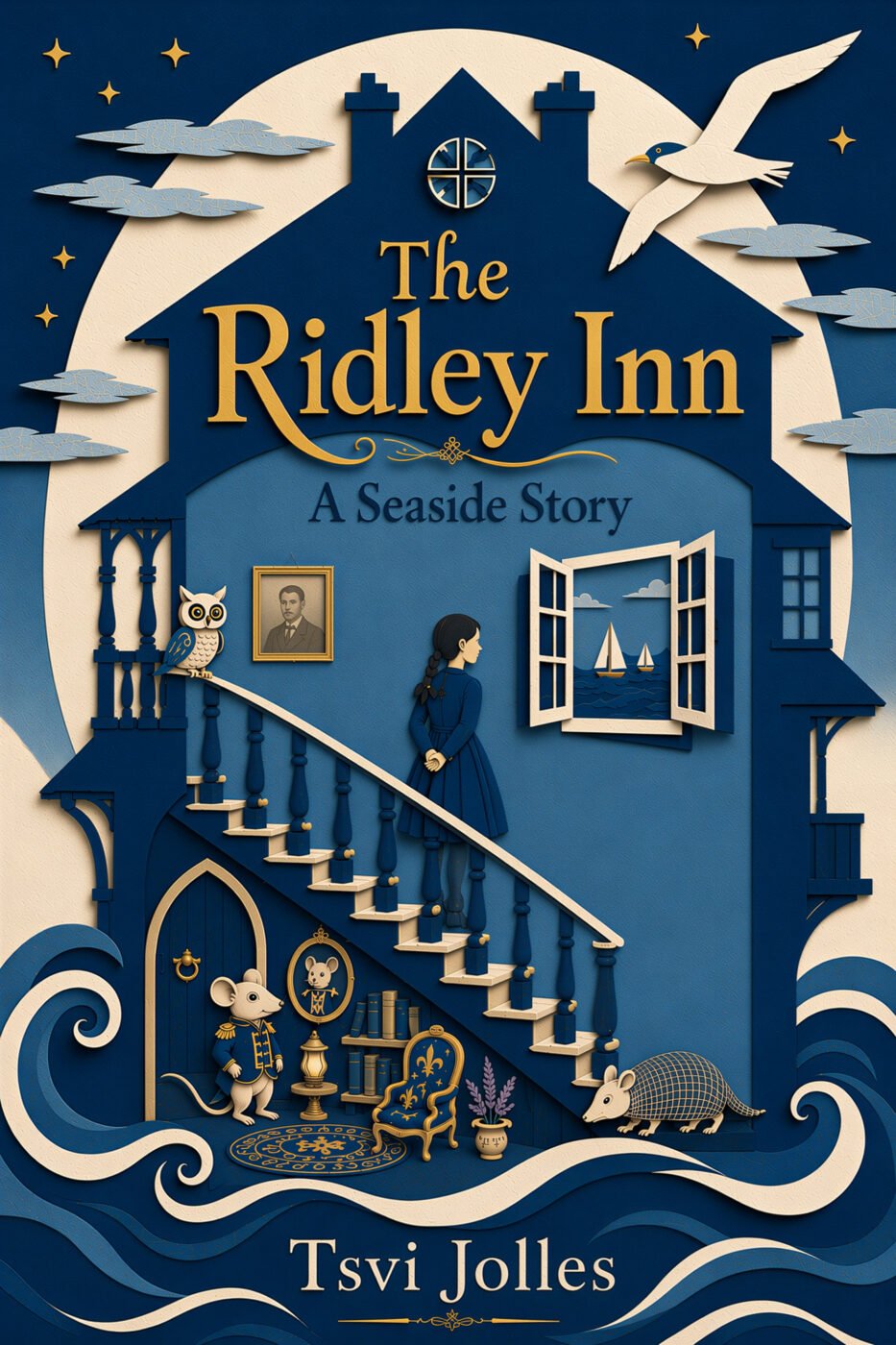
Join the advance reader list to receive a free eBook copy in exchange for an honest review.
Reviews are entirely optional, but much appreciated.
After clicking, please check your email to confirm your signup for this early reader list.